Showing posts with label rehearsals. Show all posts

Friday, 19 November 2010

Tip #54 Becoming a successful actor

(An interview with actor Jos Lawton)

In part two of an interview with Jos Lawton, who won a Best Actor award (International Filmmaker Festival, 2009) for his role as John Miller in Ambleton Delight, we explore reasons for becoming an actor and some general acting tips.

What advice would you offer those thinking about becoming an actor?
First of all, decide if you want to do it just as a hobby, or professionally. Think about why you want to be an actor. What motivates you and excites you about acting? If you want to do it professionally, you have to really, REALLY want it more than anything else. Consider how much of a priority it is in your life – if you think it might get in the way of your social life, other work commitments, drinking habits etc, then I advise you to pursue another career, and enjoy acting as a hobby.


What if you want it to be more than just a hobby?
If you think that acting could very possibly be the most exciting, challenging and rewarding job you could ever have, then throw yourself in with total conviction. Invest in yourself and get training at a drama school. Here in Brighton we are lucky to have an excellent school called the Academy of Creative Training where I trained for 2 years (as did several other Ambleton Delight cast members). In addition to drama school, immerse yourself in movies and theatre, plays and scripts, and books about actors and acting.

What about those interested in screen work?
It’s essential to familiarise yourself with film and screen techniques, as drama school training will usually only provide an introduction to this, rather than go into serious detail. After completing my training, I was aware that I needed more experience in this area, and there were several resources that I found particularly helpful: First was Patrick Tucker’s book ‘The Secrets of Screen Acting’ which is a veritable goldmine of practical advice and techniques, as is Michael Caine’s book ‘Acting in Film’. Also, the workshop run by the director Andrew Higgs, called ‘The Alchemy of Screen Acting’ – again, this comprises really useful and practical advice, and you will get great quality showreel footage from it too. I landed the role in Ambleton Delight just over a year after finishing drama school, and I feel strongly that I would have been much less prepared for the demands of a lead role in a feature film without those resources.

Any general acting tips?
  • Be spontaneous, open and flexible.
  • Trust your instincts.
  • Be fearless.
  • React truthfully.
What should actors not do?
  • Waste time or drop your concentration on set or in rehearsals.
  • Dwell on negativity, whether due to lack of work, or dissatisfaction with the acting work you are doing.
  • Be late for work. Ever!
  • And don't forget to remember why you love being an actor and above all ENJOY IT!

Wednesday, 29 September 2010

Tip #48: Try 'Guerilla' filming (if appropriate)

By Dan Parkes (Director)

The style of 'guerilla filmmaking' does not suit every project. Few would have thought it would suit a gentle relationship-heavy drama about English village politics...!

Technically, as definied in Wikipedia, it means independent low budget film making using "skeleton crews, and simple props ... shot quickly in real locations without any warning, and without obtaining permission from the owners of the locations." It is usually because filmmakers "don't have the budget to get permits, rent out locations, or build expansive sets." This often means handheld 'gritty' shots with no artificial lighting, make-up or large cinematic cameras that would draw obvious attention.

Anecdote: Wikipedia states that this style is not used by studios as they could be sued or fined. But I know from personal experience this is not always the case. I worked for an overseas studio who because clearance for a particular shot in a UK railway station was astronomically expensive, successfully filmed it guerrilla style by wandering in with a large cinematic camera in hand looking like they were about to catch a train. No one noticed until they had got 3 takes done, were questioned briefly but left with staff none the wiser that they had filmed what they wanted. I am definitely not recommending this course... but would recommend certain locations made themselves more helpful when it comes to doing some simple non-instrusive filming and are willing to pay for it.

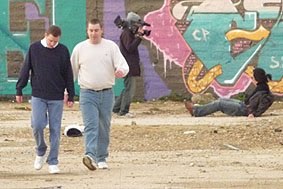
For us, guerilla filmmaking was perfect for our black and white flashback scenes which details the main character's backstory in which he gets involved in a gang and drug culture that dramatically affects his future reputation and perception of life. Crew only consisted of myself with a shoulder mounted camera (without the 35mm lenses) and I worked with the two actors, Dan Smith and Pete Allen filming almost whereever we felt like it: running down a main street, through parks, down alleyways, even beating up a Chinese actor with an ever-increasing audience watching us. We were never once stopped!


A very simple tip is to be very well prepared. We spent a lot more time rehearsing the scenes than we ever did filming them. An interesting device we used is that the camera was actually the main character's point of view (POV) so we spent time practicising how to interact with the camera as you would a person, talking to them, passing them items, being carried around (such as during the overdose sequence). It meant as a director I became part of the action -in fact one of the actors- so was a fully immersive and at times quite frightening experience.

Thursday, 16 September 2010

Tip #46: Actor's own wardrobe where possible

By Dan Parkes and Itsuka Yamasaki

There is no underestimating the importance wardrobe can have on a production, as clothes can speak volumes about a person, their personality, particular mood or character arc. But it can also be very costly if you have every member of cast being measured and fitted out in their own particular costume which may change several times during the course of the film.

Our answer was to provide wardrobe only when the actors were unable. For example, our main character John is a restaurant chef, so we purchased appropriate wardrobe including a chef's top and apron. Also, in the flashback scenes, the characters of Wayne and Andy required specific 1980s footwear and jeans, which we bought for the actors (photograph above left). Ben Rohde, who was advising us on the accuracy of the flashback scenes, also delved into his own wardrobe and found appropriate clothing from what he remembered from his experiences.

Above: Actor Brian Capron discusses his wardrobe
with production designer/producer
Sinead Ferguson and director Dan Parkes

In the case of the rest of the cast they were dressed in clothes that were readily available to them. Before rehearsals we asked them to bring along a selection of clothes they thought would be suitable for the character with some suggestions if necessary. Then at the rehearsal we would ask them to try on different clothes and take photographs and make decisions on what we think worked best, thinking about the characters state of mind and general production design issues (such as clashes with the background).

Above: Actor Andrew Elias posing in his
wardrobe during rehearsals.

In most cases we could make decisions at the rehearsal of what will work and make notes regarding this and then include a 'must-bring' on the actor's call sheet. But also some decisions were made during filming and this emphasised the need to photograph the actor in what they were wearing so as to ensure continuity matches throughout the film.

Thursday, 15 April 2010

Tip #29: The importance of rehearsals

By Dan Parkes (Director)

The quicker you can shoot the more money you will save. Feature films such as Phone Booth -shot in just 10 days- are a good example. And one of the keys to achieving this is to rehearse important scenes with your actors prior to filming. Here are 12 tips:
  1. Professional actors should be more than happy and in fact want to rehearse, but make sure that you have already discussed this and have worked out the situation regarding expenses etc
  2. Select scenes that are critical to the story narrative and that actors may have difficulty with, due to the amount of dialogue, or subtle character development.
  3. Make sure both you and the cast involved have copies of the most recent shooting script and are familiar with what scenes are to be rehearsed.
  4. Choose an appropriate location with furniture and layout that will assist the rehearsal -ideally the actual shoot location.
  5. Use the rehearsal as a time to also check wardrobe choices, to sign contracts and to check schedules for the shoot.
  6. At the beginning of the rehearsal firstly check with the cast if they have any questions regarding the scene or their character.
  7. Start with a read-through of the script -depending on the nature of the scene some may want to by-pass this step.
  8. Once you are happy with the read-through, try the scene in its entirety, progressing on to blocking options, body language and pronunciation if necessary.
  9. If a scene is not working, tell the actors to forget the script and to improvise. This will help identify the main dynamics of the scene and more natural lines of dialogue may result.
  10. Use rehearsals to explore creative options; be ready to change the script based on what happens.
  11. Always film the rehearsal so you can start exploring camera angles (make sure this is covered in the contract!).
  12. Have possible 'boot camp' options -for example our lead actor Jos Lawton spent some time working in a restaurant kitchen so that he would look authentic in his role of a restaurant chief.