Showing posts with label low budget. Show all posts

Monday, 29 November 2010

Tip #55: Prepare for the prima donna actor

By Dan Parkes (Director)

If you are a filmmaker chances are, at some point, you will come across a "prima donna" actor. Although a small minority of the acting community, due to their personality the probability of encountering them is in fact higher. For a low budget filmmaker it can be severely detrimental. All three of the Ambleton Delight production team shed literal tears during its production due to the behaviour of prima donnas in various forms (not any of the main cast I hasten to add!) and in the last three years I have personally had to handle three such actors.

Originally an operatic term, prima donna literally means "first lady" in Italian and designates the leading female singer. In modern times it has also become widely used to describe a vain or "temperamental person; a person who takes adulation and privileged treatment as a right and reacts with petulance to criticism or inconvenience." (Random House Dictionary, 2010)


Several actors have openly said they perform because they 'crave attention' which in itself is not an issue (a camera shy camera actor is a different problem!), unless it leads to egotistical behaviour. In the case of the three prima donna actors I had to deal with they were, somewhat surprisingly, all male; two were in their seventies and the other middle-aged. The causes for their behaviour, although quite different, have one common thread: money and unjustified allegations of ill-treatment. Two were aging actors who to be honest had not "made it" but relied on unknown bit-parts in TV shows or films to boost their egos; the middle-aged actor on a similar path (an unknown actor yet complaining for receiving 'only' £250 an hour).
So how to handle such an actor? You might think the answer is not to cast them in the first place. However, while warnings and references may help, any actor has the potential for this behaviour (the two aging actors mentioned previously were incredibly 'nice' to us and then seemingly 'snapped' over perceived ill-treatment). And unlike the workplace environment where a prima donna can be reassigned, you will most likely not have that option, especially if footage has already been shot. This 'cannot be done without' factor can also be one of the principle causes for their behaviour; they think they can get away with it.

So here are 10 factors to think about:
  1. Treat all actors as special, have faith in them, make them feel wanted and secure, allow them creative space and value their hard work and input.
  2. Pay your cast as well as you possibly can.
  3. Make sure you are not the prima donna! If you are a dictatorial director who lacks respect for cast and crew then you will only make matters worse.
  4. Prepare for it. It does happen and it could potentially ruin your film. Have contingency plans. It is always dangerous to be relying on one actor alone.
  5. Make sure actor's contracts and agent negotiations are comprehensive and signed, so there is no potential for confusion that can lead to unnecessary issues.
  6. Have a balanced approach. Make sure you are not being walked over or conversely making unreasonably demands. If required, be assertive and stick up for yourself and the team.
  7. Try to understand their point-of-view or motives. They may well have a good reason for complaint that should be addressed.
  8. Make room for it -the moment may pass. It could be just a phase and everything may be fine the next day. The actor could possibly be suffering from mental health issues.
  9. Find compromises. If you can calm them down by finding some middle ground then do it rather than needlessly fanning the flames if you also feel wronged.
  10. If the behaviour has got to the point of being detrimental to the project, make a final decision that is best for the film. That could simply mean recasting.

Wednesday, 29 September 2010

Tip #48: Try 'Guerilla' filming (if appropriate)

By Dan Parkes (Director)

The style of 'guerilla filmmaking' does not suit every project. Few would have thought it would suit a gentle relationship-heavy drama about English village politics...!

Technically, as definied in Wikipedia, it means independent low budget film making using "skeleton crews, and simple props ... shot quickly in real locations without any warning, and without obtaining permission from the owners of the locations." It is usually because filmmakers "don't have the budget to get permits, rent out locations, or build expansive sets." This often means handheld 'gritty' shots with no artificial lighting, make-up or large cinematic cameras that would draw obvious attention.

Anecdote: Wikipedia states that this style is not used by studios as they could be sued or fined. But I know from personal experience this is not always the case. I worked for an overseas studio who because clearance for a particular shot in a UK railway station was astronomically expensive, successfully filmed it guerrilla style by wandering in with a large cinematic camera in hand looking like they were about to catch a train. No one noticed until they had got 3 takes done, were questioned briefly but left with staff none the wiser that they had filmed what they wanted. I am definitely not recommending this course... but would recommend certain locations made themselves more helpful when it comes to doing some simple non-instrusive filming and are willing to pay for it.

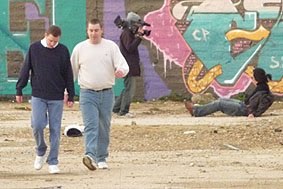
For us, guerilla filmmaking was perfect for our black and white flashback scenes which details the main character's backstory in which he gets involved in a gang and drug culture that dramatically affects his future reputation and perception of life. Crew only consisted of myself with a shoulder mounted camera (without the 35mm lenses) and I worked with the two actors, Dan Smith and Pete Allen filming almost whereever we felt like it: running down a main street, through parks, down alleyways, even beating up a Chinese actor with an ever-increasing audience watching us. We were never once stopped!


A very simple tip is to be very well prepared. We spent a lot more time rehearsing the scenes than we ever did filming them. An interesting device we used is that the camera was actually the main character's point of view (POV) so we spent time practicising how to interact with the camera as you would a person, talking to them, passing them items, being carried around (such as during the overdose sequence). It meant as a director I became part of the action -in fact one of the actors- so was a fully immersive and at times quite frightening experience.

Saturday, 27 March 2010

VIDEO BLOG: Episode 4

'Low budget does not mean low quality' was our mantra during the production. One of the keys to this was to shoot using 35mm lenses. This has recently become a much more viable option, and camera operator Roger Marshall discusses the pros and cons and also the camera and tapeless workflow used. Director of Photography Anna Carrington describes the impact shooting through 35mm lenses had on the lighting. And there is also information on how the sound was recorded and make-up. Finally, the cast discuss how they approached their roles and worked with the director.

All this and more in the fourth episode of the seven part series 'How to Make a Next-to-Nothing Budget Feature Film' exclusively on YouTube..

Wednesday, 24 February 2010

Tip #23: Production design -making it look high budget

By Sinéad Ferguson (Producer/Production designer)

The problem with many low to no budget films is exactly that, they look like no budget films. Usually the entire budget has gone on cast, crew, lighting and camera equipment. Often Production Design is an afterthought or sometimes dismissed entirely with detrimental results. On big budget films money is the ultimate problem solver, throw enough money at a problem and it goes away. The challenge on a low budget film is to achieve the same result without the money.

Even a low-budget film can have effective production design by understanding the purpose and responsibilities of the craft. Often this requires a lot of time and creativity but the results look professional and polished and anything but cheap. The easiest way to make a no budget film look expensive is by getting high production value, if what you put in front of the camera looks expensive and well finished, then the audience will assume a lot of money has been spent where it hasn’t.

The job of a production designer is to find the film’s visual potential and intent and express it in the physical environment. The primary concern for a production designer is establishing an authentic physical environment in which the actors can develop their characters and present
the story. Therefore creating and providing a cohesive visual and physical context that directly informs and supports the storytelling function.

The design of a film can create a sense of place. The atmospheric qualities of the sets, locations, and environments are essential in establishing a mood and projecting an emotional feeling about the world surrounding the film. There are many tools available through production design to accomplish this task. Locations, sets, colour palettes, props, wardrobe and so on.

The next blog post will look at how to achieve this by visually interpreting the characters.

Friday, 11 December 2009

Tip #22: Finding the right cast

By Itsuka Yamasaki (Producer/writer)

Sinéad and I worked more like casting directors, suggesting/bringing actors for director Dan's consideration. I don't think there are written rules but I would like to share how to make your life easy when arranging a casting session for a low budget film.

1. For key roles, invite only committed professional actors.
You don't want actor-director-producer-writer-musician-painter-all-at-the-sametime sort of people. You want committed actors, who have entries to some trade bodies/professional databases such as Spotlight, Equity, IMDb.

2. For key roles, invite actors with online showreels.
Headshots can be very deceiving. So you need motion pictures of the actor, which professional actors most undoubtedly have online.

3. Save your time by approaching actors rather than having them approach you.
With Ambleton Delight we decided to send personal invitations to actors that fit the profile via Casting Call Pro rather than posting casting calls (the last time we posted a casting call, we received 100+ applications including from those that did not fit the requirement at all). It made our lives a lot, lot easier.

4. Find that X-Factor.
After Ambleton we started to think it's "motion-camera genic" (interestingly, "photogenic" people don't always look good on in a moving image) and "someone who people care about" (this is not about whether people like the person or not; we don't 'like' villains but we do care what they are going to do in the movie).

5. Audition starts before you meet the actor.
Those who are good at communication tend to be easy to deal with later. When we first contacted Jos Lawton it was via e-mail and we had the impression that he was pleasant and professional (his e-mail signature contained his details as an actor such as spotlight pin, his build etc as well as usual mobile number/e-mail address). This "first impression" hasn't changed even after we shot an entire feature film with him!

6. Actors are humans with feelings.
It's true that actors are used to "rejection" and not being cast for your film might be just another one. But it's still not a nice experience. So be reasonable and decent when informing those who aren't selected for the role. You never know, you might need them in your future project!

And finally...

7. You never know.
Yes, we say this quite often. Holding auditions is a good and practical way of casting your film but really, you don't know when you meet your perfect cast for your film. For your interest I've listed how we found some cast members in Ambleton Delight other than the audition route (we did audition them but they were pretty much the only one auditioned for the role).
  • Met at another event and got on well
  • Worked together in a previous film
  • Recommended by another actor
  • Found at a local acting school database
  • Met at an audition for a previous film
  • Auditioned for another role in the film
  • Found at a local stage play