Showing posts with label film production. Show all posts

Friday, 23 September 2011

Tip #87: 12 Essential FREE video production software!

By Dan Parkes (Director/editor)

Film making can be an costly exercise, but that doesn't mean everything has to be expensive. Seeing that this is our 100th post to celebrate we are listing 12 of what we think are worth having as part of your arsenal.

Click the image to go to the official website:

1. Celtx -free production software. They have recently introduced paid subscription for using its collaborative features, but if you use it in conjunction with something like DropBox you can still use it to collaborate (although it may not be as easy).


2. Dropbox An excellent collaborative tool -meaning you can instantly share files via a common folder. The free version allows up to 2GB.


3. Muvizu If you need to some 3D previsualisation for effects shots or complicated sequences, Muvizu is free software that enables users to make 3D animations.


4. Lightworks A video editing software package that was used on the film The Kings Speech and is now open source, meaning you can download a free version of it. Looks like it has some great features. It does require 'Matrox VFW' codecs and a recent version of Apple Quicktime and is compatible with Windows XP, Windows Vista, Windows 7 32 bit and Windows 7 64 bit.

5. VLC A free open source media player which seems to play just about anything and everything! Can also be used to convert between formats and works on most platforms, Windows and Mac.

6. StarBurn (Rocket Division Software) Free CD burning, DVD burning, Blu-Ray Burning software.

7. ImgBurn A lightweight CD/DVD/HDDVD/Blu-ray burning application that enables you to burn disc images with ease. We recommend using Imgburn has a better workflow for burning multiple discs as it is faster and has verification features.

8. VisualSubSync A subtitle program that facilitates subtitle synchronization by showing you the audio form. For more information on how we used it check HERE.


9. Subtitle Workshop Free subtitle software which is good for converting subtitle formats and also translation. For more information on how we used it check HERE.

10. VirtualDub VirtualDub is a video capture/processing utility for 32-bit and 64-bit Windows platforms (98/ME/NT4/2000/XP/Vista/7). We use it to help create burned in subtitles. For more information on how we used it check HERE.

11. NVU Webpage design software that we use to create the official website. For more information on how we did that check HERE.

12. FreeFilesync An Open-Source folder comparison and synchronization tool. It is optimized for highest performance and usability without restricted or overloaded UI interfaces. A great and free method of backing up files over multiple discs or computers, especially if you cannot afford expensive backup systems such as Raid.

Note: The software was free at the time of writing. Any updates to links or additional information please comment below.

Tuesday, 1 February 2011

Tip #62: The Importance of Paperwork

By Dan Parkes (Director)

Film making can be a creative and at times very exciting process. However, such is not possible without the all important paperwork that goes behind it. I know what you are thinking, this sounds all rather boring. But like a lot of things in life, sometimes it requires the old adage of 'work before play'.

There are two very important reasons for ensuring the paperwork is never overlooked:

1. Legal obligations
If you are really serious about film production then you will likely be setting up an individual company with separate accounts -either for the film as an entity or as a production company. Becoming a company has its own set of obligations, including the paying of tax and the use of equal opportunity and privacy policies and annual reports. The film itself will require contracts over pay, public insurance liability, ownership agreements, location permits and ever important health and safety and risk assessments forms. To try to avoid any of the above -no matter what budget you are on- is a recipe for disaster. But it is also good practice for the future. And most definitely comes in useful for Errors and Omissions insurance and other festival/distribution paperwork.

2. Organisation
Ensure your paperwork is well organised and always on hand. For example, have a main file that you keep all your documentation in. Have a system for keeping receipts for items purchased or expenses from cast and crew. Have a naming system for your script so you clearly identify what version it is on every page (if the script changes during production) or use a colour coded system (different colour paper for different versions).

Make sure you have plenty of generic release forms always on set. You never know when you will need to include an extra person in a shot! And make sure they sign it before they go on camera rather than having to chase people afterwards. We experienced this on location in the village of Alfriston. While filming an establishing shot to our delight a woman on a horse rode by, perfectly completing the scene. We asked if she could do it again, but not before ensuring she had signed a waiver that producer Sinead Ferguson had on hand for such a possibility. And with a location permit, make sure you have at least two copies on set, along with the associated risk assessment paperwork, so that if asked by a passing police officer or -in a worst case scenario- there is an accident you are well prepared to answer any questions.

Your Master Film File should include:
  1. Several copies of the script (they always get lost!)
  2. Cast and crew contact list (with names, telephone numbers etc)
  3. Call sheets (plus extra copies)
  4. Shooting schedule
  5. Shot list
  6. Storyboards
  7. Accounts/receipts/expenses
  8. Maps of the area
  9. Emergency contact name and numbers
  10. Cast and crew contract/agreements
  11. Background actors release/waivers (plus loads of extra copies)
  12. Location permits
  13. Health and safety policy
  14. Risk assessments
  15. Insurance details
  16. Note pad/paper/pens
Anything we missed? Please let us know in the comments below.
Need some example forms? Check out University of North Carolina School of the Arts site.

Monday, 24 May 2010

Tip #32: Crew who work together well

By Dan Parkes (Director)

In high budget mainstream films there are many famous collaborations between directors and DOPs, such as Steven Spielberg & Janusz Kaminski, Jonathan Demme & Tak Fujimoto, Alfred Hitchcock & Robert Burks, Peter Jackson & Andrew Lesnie to name a few… (for an extensive list visit here)

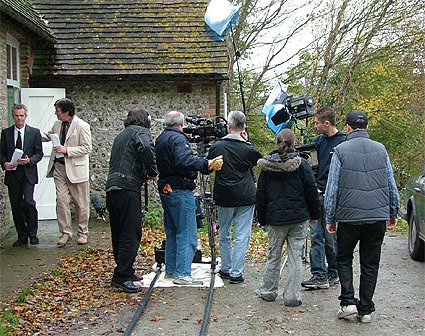
There are obvious advantages with this: a similar artistic vision and camaraderie, followed by communication shorthand (“we can set this next shot up the same way we did that similar scene in our last film”). The same is equally if not more relevant on low budget productions. It is crucial to surround yourself with people you have worked with before and you can trust to make things happen. However this is not always possible. In this case, there are some simple things to look out for when recruiting crew.

Find those who are:
  1. Good at what they do, with proof (on-line showreel, a CV, general knowledge, referee)
  2. A positive, team player (personality, references, worked with some already in your crew)
  3. Willing to multi-task and work until the job is done
  4. Has more passion for film production than money (particularly passionate about your project, not just doing it for the money)
  5. Is local to the production (save on transport expenses)
  6. Has own transport and/or equipment
Points 3 and 4 are very important; you do not want an “old-school” member of crew who will not pitch in and help when you are running short of time and need help holding a boom. Neither do you need someone who is going to complain about it not paying as well as other productions (they should already realise that!).

Also, don’t over-crew your film. Have only those who are absolutely necessary as a smaller crew who works together well can achieve more than a large, non-communicative, disorganised crew.

If you have crew you have worked with before and who have been selected carefully, then you will not only achieve your film objectives, but have lots of fun while doing so!

Sunday, 30 August 2009

Tip#6: Form a productive production team

By Sinéad Ferguson (Producer)

The Ambleton Delight production team consists of just three of us, Itsuka (writer/producer) Dan (director/producer) and myself (production designer/producer). Having previously worked together on several projects we had already established and developed a great working relationship, with a certain shorthand and knowledge of our mutual strengths, with a good mix of practical, technical, artistic and creative sensibilities.

Our weekly production meetings were integral to the success of the film. This is where we drank copious amounts of coffee and talked late into the night planning our strategies and hammering out ideas, making every single important decision regarding all aspects of the film.

Overwhelming as the work of planning a feature seemed in those early days we found the secret was to break everything down into weekly and monthly goals, with strict deadlines, by drawing up a “must–do list”. We then divided the work load between us, with each task to be completed before our next meeting. To the best of my recollection I don’t think we ever missed even one of those self imposed deadlines.

We would meet a minimum of once a week but once we got the ball rolling we found these meetings definitely increased as did our workload. After each day’s shoot we would have a post mortem where we would discuss any problems that occurred or conversely strategies that were successful. By immediately identifying issues we instantly implemented changes to the following shoot, ensuring the same problems didn’t reoccur.

So here are some important points to consider when forming your production team:
• If possible work with people you have worked well with before.
• If you are forming a team for the first time, do your research thoroughly. Trust your instincts. If you foresee personality clashes, forget it . Especially as you will be spending a tremendous amount of time with each other and often under stressful conditions. Success or failure can simply be down to having the right or wrong people on board.
• Commitment is essential. The last thing you need is someone who will bail once their initial enthusiasm has worn off and the hard work had begun.
• Play to each other’s strengths and abilities and assign tasks accordingly.
• Avoid having passengers, they’re a liability.
• It’s imperative that overall you share a unified collective vision, but that doesn’t rule out healthy debate and alternative points of view as long as a final decision is made.
• Hold your meetings somewhere you won’t be constantly interrupted, encourage open and frank discussion and have plenty of coffee on hand.
• Make every production meeting you have count. Have an agenda for each one, as it’s very easy to go off topic.
• Have everyone write a must-do list during the meeting, with weekly and monthly targets.
• Lastly remember to enjoy the experience! Take time to enjoy every little success you have along the way.